Showing posts with label The Godfather. Show all posts

Thursday, August 21, 2014

INDEX INVESTING: “YOU (DON’T) GOTTA HAVE HEART…”

8/21/14

The Wall Street Journal reports this morning (“Investors Pile Into Vanguard, Eschewing Stock Pickers”, page A1, 8/21/14) that investors are buying into index funds big time, driving Vanguard’s assets under management (“AUM”) to almost $3 trillion and making Vanguard’s Total Stock Market Index Fund the largest mutual fund in the world.  (A note is in order here; Vanguard, a firm that I advocate and highly respect is widely known as THE passive manager.  While it is the premier passive manager, and the virtual inventor of the index fund in practice, Vanguard has a big actively managed fund business, just about all of which is done through sub-advisors.  Further, you don’t have to invest with Vanguard to invest in passively managed index funds; most fund managers, even those, like Fidelity, who pride themselves in being great active managers, have substantial businesses running passive index funds.  Most of you knew that, but my readers span a wide range of financial sophistication, so I wanted to clarify that.)  Further, money flowing into index funds exceeded money flowing into actively managed funds by a factor of 6 last year and by a factor of over 2 this year.

Some of this influx has been attributed to something Warren Buffett, one of the few active (in his case, VERY active) managers who has beaten the indices over long periods of time, wrote in Berkshire Hathaway’s letter to investors in March.  He stated that he gave the following advice to the trustee of his estate:

“…put 10% of the cash in short term government bonds and 90% in a very low cost S&P 500 index fund.  (I suggest Vanguard.)”

Great minds apparently think alike (See below.); some just get to the party later than others, but getting there, not when they get there, is the key.  But I digress.

The world seems to have caught onto the argument, long advocated by yours truly (See, inter alia, EXOTIC INVESTMENT PRODUCTS FOR THE “AVERAGE GUY”:   WHAT’S THE POINT?, 8/16/13 and the posts to which it will refer you.), that index funds are the way to go.  Combine the inherent efficiency of the financial markets with the low cost and lack of manager risk of index funds and you are nearly sure to beat active managers over meaningful periods of time by investing in index funds.   Just about all my money is in index funds. 

(A point of digression here:  So why do I have any actively managed money?  That’s a long and not all that interesting story that I will save for another time.  For now, suffice to say that almost all of my non-index money is invested in funds that use screening techniques and thus eliminate, or at least minimize, manager risk, much like index funds, and keep costs reasonably low, though not as low as index funds.  I like to refer to them as “index-like” products and they play a limited role in my portfolio.  Much of my remaining non-index money is there to entertain myself, to indulge my market prognostication propensities while keeping my acting on those propensities away from amounts of money that would really matter.   So, while I don’t have ALL my money in index funds, I eat my own cooking; just about all of it is in index funds.  Of course, lately, all my money doesn’t amount to very much, but that is another issue.)

Many years ago, when I was managing portfolios at a big Chicago bank, I appeared at a forum sponsored by a major mutual fund company with whom we did business.  This particular family of funds, which will remain nameless, was and is primarily an active manager and an advocate for active management.  At this forum, I was there to represent the passive investing argument and the deck was stacked against me, but the sponsoring fund family was, and is, good people and I was confident enough in my argument that the set-up didn’t bother me.

After I made my pitch for index funds, the firm’s representative said something like (paraphrasing, not quoting; it was a long time ago):

What Mark is advocating is putting your money with a manager who has no brain.   Does that make any sense?

It looked as though he had me, until I retorted

Yes, I agree that an index fund has no brain.  But it also has no heart; it invests without emotions.  In your life, when you’ve made mistakes, was it because you weren’t smart enough to avoid those mistakes or because you let your emotions get the better of you?  

The answer, to most people was obvious.  I went on.

It’s the same with investing.   For the most part, money managers are very smart people.  (Perhaps I exaggerated a bit here, but I digress.)   It’s not a lack of intellect that gets them into trouble.  It’s their emotions.   They won’t sell a losing position that is getting worse.  They won’t add to a losing position that is only becoming an even more compelling value.  They continue to add to a winning position that has gotten way too rich.  It’s human nature that leads to investment mistakes.  Index funds eliminate the emotion from the process.  So, yes, I would rather invest with a manager with no brain…as long as it also lacked a heart.

I don’t know whether I won the day there, but I was quite happy with my defense of index funds and passive investing.  I have more or less stuck to that philosophy until this very day and probably will for the rest of my life, with at least one caveat:

Index investing does not entirely remove the emotion from investing.  Effective index investing (or even active investing) still requires nearly religious rebalancing (See, inter alia, Bill Gross Has A “Bad” Year:   Lessons For Your Portfolio, Rant Lifestyle, 1/4/14) and emotion can certainly get in the way of effective rebalancing; who wants to sell “winners” to buy “losers,” which is one of the things rebalancing forces us to do.  So to nearly eliminate all emotion from investing, even the dangerous emotions that come into play at rebalancing time, one would have to invest in a balanced index fund, or set up an arrangement in which your index funds are automatically rebalanced for you by the fund company.  Such arrangements are growing increasingly common.  Or you can do what my clients (at the time, mostly institutions) did:  hire a manager to do the emotionally wrenching things for you.


If you want to entertain yourself, do what I do:  watch “The Godfather” again, read a compendium of the musings of H.L. Mencken, watch “Shark Tank,” drive long distances in a car with a manual transmission and satellite radio, watch Big 10 football and basketball, read and write about politics…and maybe trade a few dollars like a scalded dog and hope to keep your underperformance, or outright losses, reasonable.  If you want to invest sensibly, buy index funds and religiously rebalance.

Wednesday, May 8, 2013

THE CULLERTON PENSION PLAN: “THE (PUBLIC EMPLOYEE UNIONS) FAMILY DON’T EVEN HAVE THAT KIND OF MUSCLE ANY MORE”???

5/8/13 

On Monday, State Senate President John Cullerton unveiled the multi-faceted approach to pension reform that he formulated in collaboration with the leaders of the state chapters of AFSCME, SEIU, and the AFL-CIO along with leaders of the IFT and IEA.   As readers will recall, Mr. Cullerton was in something of a snit when House Speaker Mike Madigan came up with his own plan for addressing Illinois’ $100 billion unfunded pension liability and vowed to come up with his own plan; see my 5/2/13 piece MIKE MADIGAN’S PENSION REFORM PLAN:  “THE BEST THAT (WE) CAN HOPE FOR IS TO DIE IN (OUR) SLEEP.” 

Mr. Cullerton’s plan is complicated because it offers workers a menu of choices, but its common theme is a trade-off between continuing to receive retiree health benefits and having pension cost of living (“COLA”) adjustments grow at simple interest rather than compound .  Unlike Mr. Madigan’s plan, Mr. Cullerton’s union backed plan would not increase the retirement age for state workers or limit the amount of a worker’s pension subject to COLA adjustment.   Again, see my 5/2/13 piece for details of the Madigan plan.

The Cullerton plan has a few virtues.  One is that, since it does not directly reduce retirees’ benefits but instead offers workers and retirees something of a Hobson’s choice between health care benefits in retirement and reduced pension benefits, the plan is less likely than the Madigan plan to run afoul of the Illinois constitution’s provision that pension benefits of public employees cannot be “diminished or impaired.”   One wonders, however, given the highly politicized nature of the court system in this state, whether any plan with the full backing of Mike Madigan would encounter more than rhetorical resistance even in the state Supreme Court.

Another virtue of the Cullerton plan is that it has the backing of, and indeed was formulated in association with, the state’s public employee unions, who are apoplectic over the Madigan plan.   But one wonders (I’m not being disingenuous here; one really does wonder.) how much muscle the public employee unions have any more.  That Mr. Madigan, a life long ally of those unions, formulated a pension plan that ostensibly sent the unions through the roof indicates that perhaps Mr. Madigan, the state’s shrewdest politician, doesn’t think the unions hold the aces they once did.


Those virtues are more than offset by the Cullerton plan’s major weakness:  it does little to address the state’s gaping budget hole.  The Cullerton plan reduces the state’s $100 billion unfunded pension liability by $10 billion while the Madigan plan lops of $30 billion, and even that $30 billion is not enough.   If we insist on getting into the fantasy land of the distant future, the Cullerton plan saves the state $46 billion over the next 30 years while the Madigan plan supposedly saves the state $140 billion.   But that larger number depends on the state’s politicians’ keeping their promises, albeit, according to the Madigan plan, legally enforceable promises. (This enforcement mechanism would only force bankruptcy…if the state isn’t already in court by 2019, the date of the first enforceable payment…more quickly if the state’s finances don’t begin to show nearly impossible improvement.  But that is grist for another mill.).   And since when have this state’s, or any state’s, politicians kept their promises?   One of the reasons this problem arose is because our state’s “leaders” refused to honor promises to fund pensions.


Two other points worth pondering…

First, doubtless some will, if they haven’t already, argue that the whole Madigan/Cullerton plan is part of some Machiavellian dance to avoid doing anything about our pension problems.   The Madigan plan has passed the House, the Cullerton plan will pass the Senate, and the whole thing will die in conference.   This doesn’t make much sense, though.  Why would Mike Madigan so infuriate the unions, especially when his daughter is apparently conducting a campaign for governor, while achieving nothing?   The unions may not have the power they once did, but it makes no sense, especially to someone as savvy as Mike Madigan, to incur their wrath for nothing. 

Some might argue the unions are in on the whole conspiracy.  While this is plausible, remember the old adage about the reducing likelihood of keeping a conspiracy secret as the number of conspirators grows.   Talk of a Madigan/Cullerton plan to appear to be doing something about pensions while doing nothing is even too cynical for yours truly and assumes Mike Madigan is even more Machiavellian than he is…isn’t it?

 Second, even if something does get done on pensions, one cannot be sanguine about the fiscal future of our state.  Note John Cullerton’s comments as he unveiled his proposal

“We know we have to pass a pension reform bill this year.  We’re the worst funded in the nation.  It’s affecting our budget.  We have to free up money next fiscal year and fiscal years after that.  And that’s why we have to pass these bills.  We know that.”  (Emphasis mine)

One suspects that when the likes of John Cullerton speak of “free(ing) up money,” it’s not to roll back the “temporary” income tax increase he and Mr. Madigan passed with the help of Governor Quinn a few years ago.   Mr. Cullerton is talking instead of “free(ing) up money” for, you guessed it, more spending…on “the children,” or “public safety,” or “health care,” or any of the many anodyne labels politicians put on ladling out your money to their contributors.  What will have been achieved if we save money on pensions only to blow it on something else?


See my two books, The Chairman, A Novel of Big City Politics and The Chairman’s Challenge, A Continuing Novel of Big City Politics, for further illumination on how things work in Chicago and Illinois politics. 

Sunday, April 28, 2013

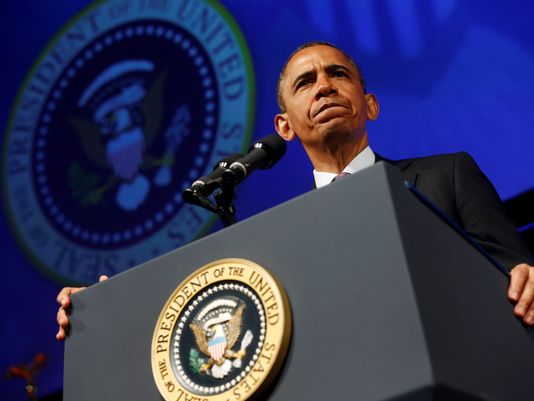
OBAMA AND SYRIA: “…AND A MAN IN MY POSITION CANNOT AFFORD TO LOOK RIDICULOUS!”

4/28/13

Much criticism is being directed toward President Obama due to his clumsy handling of the Syrian situation.   The President had previously said that the use of chemical weapons by the Assad regime would be a “red line,” presumably tripping more vigorous U.S. action on behalf of the amorphous bands of rebels seeking to seize power in Syria.  (See my 4/11/13 piece, SYRIA:  GROUNDHOG DAY FOR AMERICAN FOREIGN POLICY.)   When both the Israelis and our own intelligence sources confirmed that the Assad regime had used chemical weapons against its own population, the President hemmed and hawed, talking about wanting to be very careful before taking further steps toward active military involvement in Syria.   It’s easy to understand, and encourage, the President’s caution; there are those of us who have not forgotten the eagerness of the Bush crowd to get us into the huge military mistakes known as Iraq and Afghanistan.  But the President’s caution looks like pusillanimousness to his enemies and even to objective observers.  What once looked was a red line is starting to fade to a pink line, as some of his critics are fond of saying.


Mr. Obama is indeed looking quite ridiculous at this juncture, but not for the reasons the likes of Senators John McCain and Lindsey Graham would have you believe.  The President does not look silly and indecisive because he is not reacting to Mr. Assad’s use of chemical weapons, but because Mr. Obama drew a red line in the first place.   Rather than saying that use of chemical weapons would be the tripwire for further U.S. involvement in Syria, the President should have stated unequivocally that the conflict in Syria is none of our business, that we have no dog in that fight, and that we are not going to get involved in that conflict.   Period.


Why is yours truly so adamant about keeping us out of Syria?   Again, see my 4/11 piece, but also note the arguments of Senator Lindsey Graham, John McCain’s mini-me, on Face the Nation this (Sunday, 4/28) morning.   Mr. Graham is, of course, urging greater involvement in Syria but not “boots on the ground,” no sir.  He instead favors such restrained measure as enforcing no-fly zones, using “cruise missiles” to destroy Syrian airfields, and vague measures to “secure Syria’s chemical weapons stockpiles.”  Mr. Graham argues that if we do nothing, some combination of four things is going to happen.

  1. Syria will become a failed state.
  2. Syria’s chemical weapons will fall into the “wrong hands.”
  3. Jordan will be overrun with refugees, threatening the regime of King Abdullah, whom Mr. Graham cites as a “loyal ally.”
  4. The Iranians, emboldened by our lack of action, will move more quickly to develop nuclear weapons and foment trouble in the Middle East and beyond.

Well, guess what, Senator?   All those things, with the possible exception of the fourth, either have taken place or are going to take place regardless of what we do in Syria.   We have little to no influence on the parties fighting in Syria and, despite elements of our foreign policy apparatus again having fallen for the usual song and dance about “moderate, pro-Western elements,” we have no friends on either side of the Syrian conflict.   We have plenty of people who will flit around Washington professing friendship with America in order to line their own pockets, but we have no genuine friends in Syria.   We can’t influence the outcome of the war and, even if we could, no outcome will be favorable to us or to broad swaths of the Syrian people.   Syria is a mess and has become a hellhole.  Nothing we do can change that; the only impact of American involvement will be further shedding of American blood and expenditure of American money.   Funny how all this concern about the precarious state of federal finances goes out the window when the War Party sees a conflict in which it can get us involved, but I digress.

One would have thought that intelligent, or even sentient, people would have learned something about the limits of American power and influence from the debacles in Iraq and Afghanistan, both of which are failed states, bristling with weapons and breeding legions of terrorists and one of which may very well become an Iranian satellite.  Both of have cost us plenty of American lives and hundreds of billions of dollars we don’t have… and to no good end.

But we don’t learn.   Or, more properly, in a society that seems to equate militarism with patriotism and in which politicians need money from “defense” contractors to sustain their fantasy lives they call careers, we decide not to learn and rush to the next opportunity to prolong conflict, destroy lives, and create enemies.